Marriage is one of the most sacred samskaras in Sanatan Dharma. Before two individuals begin their lifelong journey together, families have traditionally consulted Vedic astrology to evaluate their compatibility. One of the oldest and most respected methods for this purpose is Ashta Koota Matching.
For centuries, Ashta Koota Matching has been used to assess various aspects of compatibility between a prospective bride and groom. Rather than relying on emotions alone, this traditional system evaluates eight important areas of compatibility based on the Moon sign and Nakshatra of both individuals.
However, many people misunderstand Ashta Koota Matching by believing that obtaining a high score alone guarantees a successful marriage. In reality, experienced Vedic astrologers always analyse the complete birth chart, including the seventh house, Navamsa (D9), planetary strengths, Mangal Dosha, planetary periods, and overall marriage yogas before offering guidance.
This comprehensive guide explains what Ashta Koota Matching is, how the traditional 36-point system works, the significance of each koota, and why complete horoscope analysis remains essential before making important marriage decisions.
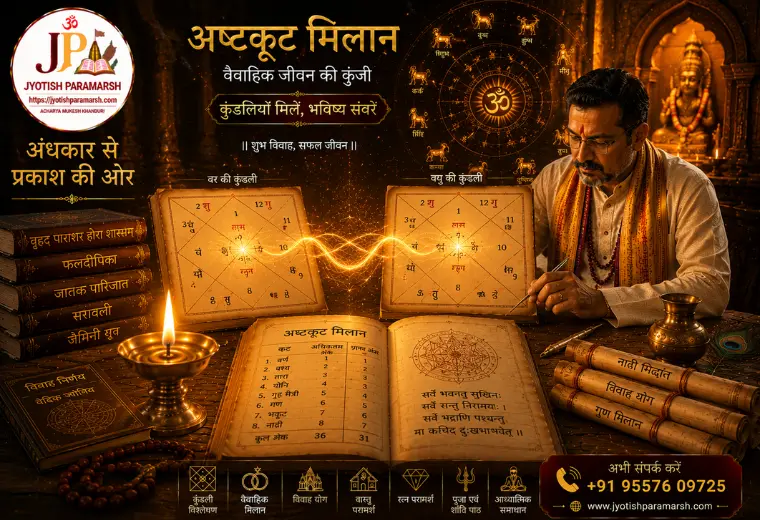
What is Ashta Koota Matching?
Ashta Koota Matching is a traditional Vedic astrology method used to evaluate marriage compatibility between two individuals. It analyses eight different compatibility factors, known as kootas, and assigns a maximum score of 36 points. These points help astrologers understand different aspects of compatibility before marriage.
To understand the traditional 36-point compatibility system in greater detail, read our complete guide on Guna Milan.
Quick Answer
Ashta Koota Matching is the traditional eight-fold compatibility system used in Vedic astrology before marriage. It evaluates eight kootas and assigns up to 36 points, but experienced astrologers always interpret these results together with the complete horoscope rather than relying on the score alone.
Key Takeaways
- Ashta Koota Matching evaluates eight important compatibility factors.
- The highest possible score is 36 points.
- Higher scores generally indicate stronger traditional compatibility.
- The complete horoscope is always more important than the score alone.
- Navamsa (D9), planetary strength, and marriage yogas should also be analysed.
- Personal values, communication, and mutual respect remain essential for a successful marriage.
Table of Contents
- What is Ashta Koota Matching?
- History of Ashta Koota Matching
- Importance of Ashta Koota Matching
- How Ashta Koota Matching Works
- The Eight Kootas Explained
- The 36-Point System
- Is a High Score Always Good?
- Common Misconceptions
- FAQs
- Conclusion
History of Ashta Koota Matching
The principles of the eight-koota compatibility system originate from classical Vedic astrology and have been followed in India for many centuries.
The word:
- Ashta means eight.
- Koota means category or aspect.
- Matching refers to compatibility analysis.
The system was developed to evaluate compatibility in multiple dimensions rather than focusing on only one characteristic.
Today, the traditional 36-point compatibility system continues to be one of the most widely used methods for traditional marriage compatibility assessment.
Why is Ashta Koota Matching Important?
The primary purpose of the traditional 36-point compatibility system is to understand traditional compatibility before marriage.
It helps astrologers evaluate factors such as:
- Mental compatibility
- Emotional understanding
- Family harmony
- Mutual attraction
- Health-related traditional indicators
- Prosperity
- Long-term relationship potential
It is important to remember that these factors are always interpreted together with the complete horoscope.
How Does Ashta Koota Matching Work?
the traditional 36-point compatibility system is calculated using the Moon sign (Rashi) and birth Nakshatra of both individuals.
The process generally includes:
- Preparing both birth charts.
- Identifying Moon signs.
- Identifying Nakshatras.
- Calculating the score for each koota.
- Adding the scores to obtain a total out of 36.
- Studying the complete horoscope before giving final guidance.
You should also explore our detailed article on Horoscope Matching, which explains complete birth chart compatibility beyond the eight kootas.
Information Required for Ashta Koota Matching
Accurate calculations require:
- Date of birth
- Time of birth
- Place of birth
Incorrect birth details may affect the accuracy of the compatibility assessment.
Understanding the Eight Kootas
The foundation of the eight-koota compatibility system lies in eight traditional compatibility categories.
Each koota evaluates a different aspect of married life.
1. Varna Koota (1 Point)
Varna Koota represents traditional spiritual compatibility.
It is associated with:
- Spiritual values
- Personal growth
- Mutual respect
- Traditional outlook
Although it carries only one point, it forms an important part of the overall assessment.
2. Vashya Koota (2 Points)
Vashya Koota evaluates mutual influence and adaptability.
It traditionally relates to:
- Attraction
- Cooperation
- Adjustment
- Relationship balance
This koota attempts to understand how two individuals may influence each other within a relationship.
3. Tara Koota (3 Points)
Tara Koota is associated with wellbeing and auspiciousness.
Traditional interpretations include:
- Health
- Good fortune
- Prosperity
- Overall harmony
It is calculated using the birth Nakshatras of the couple.
4. Yoni Koota (4 Points)
Yoni Koota studies physical and emotional compatibility.
It is traditionally connected with:
- Attraction
- Emotional bonding
- Physical compatibility
- Relationship intimacy
This is considered an important component of long-term marital harmony.
5. Graha Maitri Koota (5 Points)
Graha Maitri Koota analyses the friendship between the ruling planets of the couple’s Moon signs.
It provides traditional insights into:
- Mental compatibility
- Communication
- Friendship
- Understanding
- Emotional connection
Strong Graha Maitri is generally considered favourable for long-term companionship.
6. Gana Koota (6 Points)
Gana Koota evaluates personality and temperament.
The three traditional ganas are:
- Deva Gana
- Manushya Gana
- Rakshasa Gana
This koota attempts to understand behavioural compatibility and day-to-day interaction between partners.
7. Bhakoot Koota (7 Points)
Bhakoot Koota studies the relationship between the Moon signs of the prospective bride and groom.
Traditional interpretations relate to:
- Family happiness
- Financial stability
- Domestic harmony
- Long-term prosperity
Bhakoot is one of the highest-scoring components in the eight-koota compatibility system and is interpreted carefully by experienced astrologers.
8. Nadi Koota (8 Points)
Nadi Koota carries the highest weight in the eight-fold matching system.
Traditionally, it is associated with:
- Health
- Vitality
- Family wellbeing
- Progeny-related considerations
When Nadi Dosha is indicated, experienced astrologers study the complete horoscope and recognised exceptions before offering any conclusion.
The Complete 36-Point Scoring System
The total score in the eight-koota compatibility system is calculated by adding the points obtained from all eight kootas.
| Koota | Maximum Points |
|---|---|
| Varna | 1 |
| Vashya | 2 |
| Tara | 3 |
| Yoni | 4 |
| Graha Maitri | 5 |
| Gana | 6 |
| Bhakoot | 7 |
| Nadi | 8 |
| Total | 36 |
The final score is used as an initial compatibility indicator. However, experienced astrologers never base marriage recommendations solely on this score.
What Score is Considered Good?
Traditionally, the following ranges are commonly used as general guidance:
| Score | Traditional Interpretation |
| Below 18 | Detailed horoscope analysis strongly recommended |
| 18–24 | Average traditional compatibility |
| 25–32 | Good traditional compatibility |
| 33–36 | Excellent traditional compatibility |
These ranges should be viewed only as general guidelines. A lower score does not automatically indicate an unsuccessful marriage, and a higher score does not guarantee lifelong happiness.
This is why the eight-koota compatibility system should always be combined with a complete Vedic horoscope analysis before making important marriage decisions.
Is Ashta Koota Matching Alone Enough?
The simple answer is No.
One of the biggest misconceptions about the eight-koota compatibility system is that the final 36-point score alone determines whether a marriage will be successful. In reality, experienced Vedic astrologers consider the eight-koota compatibility system as one important part of a much broader marriage compatibility analysis.
Along with the eight-koota compatibility system, astrologers also evaluate:
- The Seventh House
- The Seventh Lord
- Navamsa (D9 Chart)
- Venus
- Jupiter
- Moon
- Marriage Yogas
- Mangal Dosha
- Nadi Dosha
- Bhakoot Dosha
- Planetary Strength
- Mahadasha and Antardasha
- Overall horoscope balance
Only after studying all these factors together is personalised marriage guidance provided.
Experienced astrologers also evaluate Marriage Yog in Kundli before providing personalised marriage guidance.
Can Marriage Be Successful with a Low Ashta Koota Matching Score?
Yes.
A lower the eight-koota compatibility system score does not automatically mean a marriage will be unsuccessful.
Many couples with moderate scores enjoy happy and stable marriages because of:
- Strong marriage yogas
- Supportive planetary aspects
- Favourable Navamsa placements
- Dosha cancellation rules
- Emotional maturity
- Mutual trust and communication
- Shared values and respect
Likewise, a high score does not guarantee lifelong marital happiness if other important horoscope factors are weak.
If you want to understand marriage timing, read our comprehensive guide on Marriage Prediction by Date of Birth.
Our detailed article on Mangal Dosha explains why Mars is an important factor in traditional marriage astrology.
You may also benefit from reading our complete guides on Nadi Dosha and Bhakoot Dosha, two important components of the the eight-koota compatibility system.
Does 36 Out of 36 Guarantee a Happy Marriage?
No.
Although a score of 36 out of 36 is traditionally considered highly favourable, Ashta Koota Matching should never be interpreted as a guarantee of marital success.
Challenges may still arise if:
- The seventh house is weak.
- Venus is significantly afflicted.
- Marriage yogas are weak.
- Difficult planetary periods are active.
- Practical compatibility is lacking.
- Communication and mutual understanding are poor.
Astrology is traditionally viewed as a guide rather than a certainty.
Common Myths About Ashta Koota Matching
Myth 1: A High Score Guarantees a Perfect Marriage
Reality: the eight-koota compatibility system provides traditional compatibility insights, but complete horoscope analysis remains essential.
Myth 2: Less Than 18 Points Means Marriage Should Never Take Place
Reality: Many horoscopes with lower scores contain strong marriage-supporting combinations that experienced astrologers identify.
Myth 3: Nadi Dosha Automatically Cancels Marriage
Reality: Nadi Dosha is carefully analysed together with recognised cancellation rules and the complete horoscope.
Myth 4: Online Ashta Koota Matching Is Sufficient
Reality: Online calculators provide preliminary compatibility scores but cannot evaluate complex planetary combinations.
Myth 5: Ashta Koota Matching Predicts Divorce
Reality: the eight-koota compatibility system evaluates traditional compatibility. It does not predict future events with certainty.
Online Ashta Koota Matching vs Professional Horoscope Analysis
Many couples begin with free online compatibility calculators.
However, professional analysis provides significantly deeper insights.
| Feature | Online Ashta Koota Matching | Professional Analysis |
|---|---|---|
| 36-Point Score | ✔ | ✔ |
| Eight Koota Analysis | ✔ | ✔ |
| Complete Horoscope Study | ✘ | ✔ |
| Marriage Yogas | Limited | ✔ |
| Navamsa (D9) | Usually Limited | ✔ |
| Planetary Strength | Limited | ✔ |
| Mahadasha Analysis | ✘ | ✔ |
| Personal Guidance | ✘ | ✔ |
Who Should Perform Ashta Koota Matching?
the eight-koota compatibility system is commonly recommended for:
- Couples planning an arranged marriage
- Couples considering a love marriage
- Families seeking traditional compatibility guidance
- Individuals evaluating marriage proposals
- Anyone wishing to understand Vedic marriage compatibility before marriage
Traditional Spiritual Practices Before Marriage
Many Hindu families combine the eight-koota compatibility system with traditional spiritual practices before marriage.
Common practices include:
- Worship of Lord Shiva and Goddess Parvati
- Mahamrityunjaya Mantra chanting
- Hanuman Chalisa recitation
- Rudrabhishek
- Charity and selfless service
- Guidance from an experienced Vedic astrologer
These practices are followed with faith and devotion rather than as guarantees of specific outcomes.
Many devotees also perform Rudrabhishek while praying for harmony, stability, and happiness in married life.
Chanting the Mahamrityunjaya Mantra is another traditional practice followed by many families before marriage.
Scientific and Traditional Perspective
People often ask whether Ashta Koota Matching is scientifically proven.
Modern science has not established astrology as a scientifically validated method for predicting marriage compatibility. However, Ashta Koota Matching remains an important part of India’s cultural and spiritual heritage and continues to be followed by millions of families as a traditional guidance system.
Marriage decisions should ideally combine astrological guidance with communication, emotional maturity, shared values, financial planning, health considerations, and mutual respect.
Benefits of Ashta Koota Matching
1. Structured Compatibility Assessment
Ashta Koota Matching provides a systematic framework for evaluating traditional marriage compatibility.
2. Better Marriage Preparation
It encourages meaningful discussions before marriage and helps identify areas that may require greater understanding.
3. Supports Balanced Decision-Making
Families receive traditional guidance while considering the complete horoscope.
4. Encourages Comprehensive Horoscope Analysis
The process reminds couples that the complete horoscope is more important than the score alone.
5. Reduces Misconceptions
Professional consultation helps clarify misunderstandings created by incomplete online reports.
FREE Garhwali Bride & Groom Registration
Looking for a suitable Garhwali bride or groom?
Jyotish Paramarsh offers dedicated matchmaking support for Garhwali families.
Limited-Time Offer
✅ FREE Registration
Services include:
- Personalised Matchmaking
- Ashta Koota Matching
- Horoscope Matching
- Kundli Matching
- Marriage Compatibility Analysis
- Garhwali Community Matchmaking
📞 Call / WhatsApp: +91 95576 09725
🌐 Website: https://jyotishparamarsh.com/
You may also enjoy our article on Love Marriage vs Arranged Marriage in Astrology, which compares both relationship paths from a Vedic astrology perspective.
Many of the concepts used in Ashta Koota Matching are rooted in classical Sanskrit literature and traditional Jyotish texts that continue to guide Vedic astrology today.
Conclusion
Ashta Koota Matching remains one of the most respected and widely practised compatibility systems in Vedic astrology. By evaluating eight traditional compatibility factors through the 36-point system, it provides valuable guidance before marriage. However, experienced astrologers never rely solely on the final score.
A complete marriage assessment should also include the seventh house, Navamsa (D9), marriage yogas, planetary strengths, doshas, and planetary periods. When combined with communication, trust, emotional maturity, and shared values, Ashta Koota Matching becomes a meaningful part of thoughtful marriage planning rather than the sole deciding factor.
Frequently Asked Questions (FAQ)
What is Ashta Koota Matching?
Ashta Koota Matching is the traditional eight-fold compatibility system used in Vedic astrology to assess marriage compatibility using a maximum score of 36 points.
How many points are there in Ashta Koota Matching?
The maximum possible score in Ashta Koota Matching is 36 points.
Is 18 points acceptable in Ashta Koota Matching?
Traditionally, 18 or more points are generally considered acceptable. However, the complete horoscope should always be analysed before making marriage decisions.
Can marriage be successful with a low Ashta Koota Matching score?
Yes. Many couples with moderate or lower scores enjoy successful marriages because of favourable planetary combinations and strong mutual understanding.
Does 36 out of 36 guarantee a successful marriage?
No. Ashta Koota Matching provides traditional compatibility guidance but cannot guarantee lifelong marital happiness.
Is Ashta Koota Matching the same as Guna Milan?
Yes. Ashta Koota Matching is the traditional eight-category system used to calculate the 36-point Guna Milan score.
Is online Ashta Koota Matching accurate?
Online calculators provide preliminary compatibility scores but cannot replace personalised analysis by an experienced astrologer.
What information is required for Ashta Koota Matching?
Accurate date of birth, exact birth time, and birthplace are generally required.
Does Ashta Koota Matching predict divorce?
No. Ashta Koota Matching evaluates traditional compatibility and should not be interpreted as predicting future events.
Should love marriage couples also perform Ashta Koota Matching?
Yes. Many couples planning a love marriage also choose Ashta Koota Matching as part of their overall marriage compatibility assessment.