Marriage is regarded as one of the most sacred samskaras in Sanatan Dharma. Every couple hopes for a happy, stable, and fulfilling relationship. Yet, like every human relationship, marriage can also experience misunderstandings, emotional distance, financial stress, health issues, family disagreements, or compatibility challenges.
This is why many people search for Divorce Yoga in Kundli, hoping to understand whether Vedic astrology discusses planetary combinations that are traditionally associated with marital difficulties.
According to traditional Vedic astrology, Divorce Yoga in Kundli is not determined by a single planet, one house, or one yoga. Experienced astrologers study the entire horoscope—including the 2nd house, 4th house, 6th house, 7th house, 8th house, 12th house, Venus, Jupiter, Moon, Navamsa (D9), planetary strengths, Mahadasha, Antardasha, and transits—before offering any interpretation.
Importantly, traditional astrology does not teach that any single combination guarantees separation or divorce. Instead, certain combinations are traditionally interpreted as indicating a greater possibility of marital challenges, and those indications are considered alongside many other factors in the birth chart as well as real-life circumstances.
In this comprehensive guide, you’ll learn how Divorce Yoga in Kundli is traditionally interpreted, which planets and houses are commonly examined, why the complete horoscope matters, and how Vedic astrologers approach marital compatibility.
Marriage customs in India have evolved through centuries of cultural and spiritual traditions. Readers interested in learning more about India’s cultural heritage may refer to India’s cultural heritage.
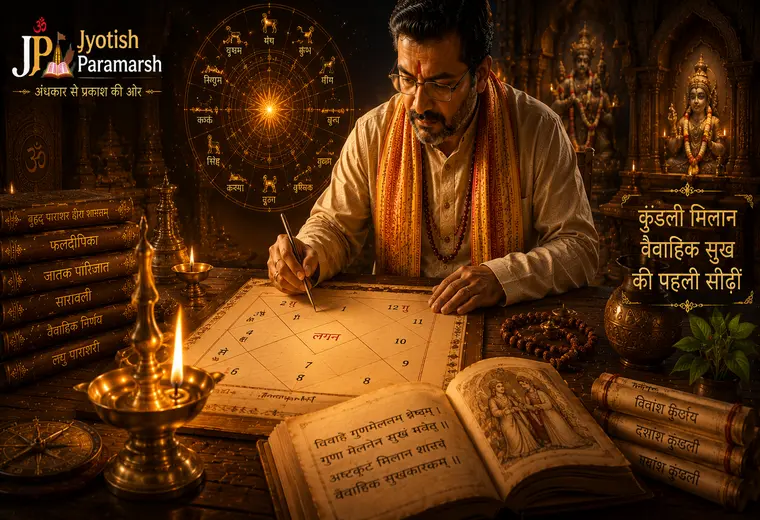
What is Divorce Yoga in Kundli?
Divorce Yoga in Kundli is a traditional Vedic astrology term used to describe certain planetary combinations that some astrologers associate with increased marital challenges or the possibility of separation. These combinations are never interpreted in isolation and should always be evaluated within the context of the complete birth chart.
Quick Answer
Divorce Yoga in Kundli refers to traditional astrological combinations that some Vedic astrologers study while assessing marital harmony. No single yoga or planet can predict divorce, and a complete horoscope analysis is essential before drawing conclusions.
Key Takeaways
- Divorce Yoga is a traditional Vedic astrology concept.
- No single planet causes divorce.
- The complete horoscope is always analysed.
- Navamsa (D9) plays an important role.
- Mahadasha and planetary transits are also considered.
- Communication, mutual respect, and personal choices remain essential for a successful marriage.
Table of Contents
- What is Divorce Yoga in Kundli?
- Why Complete Horoscope Analysis Matters
- Important Houses
- Important Planets
- Traditional Planetary Combinations
- Role of Navamsa
- Mahadasha and Gochar
Why Complete Horoscope Analysis Matters
One of the biggest misconceptions is that a single yoga can determine the future of a marriage.
Traditional Vedic astrology instead examines:
- Birth Chart (D1)
- Navamsa (D9)
- Seventh House
- Seventh Lord
- Venus
- Jupiter
- Moon
- Mars
- Saturn
- Rahu and Ketu
- Planetary Strength
- Yogas
- Mahadasha
- Antardasha
- Current Transits
Every horoscope is unique, and experienced astrologers traditionally consider all these factors together before offering guidance.
Learn how complete compatibility is traditionally evaluated in our detailed guide on Horoscope Matching.
Important Houses Studied in Divorce Yoga in Kundli
Traditional Vedic astrology pays special attention to several houses while analysing marriage-related matters.
1. Second House
The second house traditionally represents:
- Family
- Domestic harmony
- Shared values
- Financial stability
- Family relationships
Its condition is considered important while evaluating overall marital stability.
You may also find our article on Marriage Yog in Kundli helpful for understanding marriage-supporting planetary combinations.
2. Fourth House
The fourth house is associated with:
- Emotional peace
- Home environment
- Domestic happiness
- Comfort
- Family life
Supportive influences on this house are generally regarded as beneficial for family harmony.
3. Sixth House
Traditionally, the sixth house is connected with:
- Disagreements
- Legal matters
- Conflicts
- Obstacles
- Daily challenges
Its relationship with marriage-related houses is sometimes examined while studying marital difficulties.
4. Seventh House
The seventh house is the primary house of marriage.
Astrologers traditionally analyse:
- Seventh Lord
- Occupying planets
- Benefic aspects
- Malefic aspects
- Marriage yogas
This house remains one of the most important foundations of marriage analysis.
5. Eighth House
The eighth house traditionally represents:
- Sudden changes
- Shared resources
- Longevity of relationships
- Transformation
- Emotional depth
Its condition may also be considered while evaluating long-term marital developments.
6. Twelfth House
The twelfth house is associated with:
- Expenses
- Isolation
- Emotional withdrawal
- Foreign residence
- Spiritual growth
Traditional astrologers sometimes evaluate its connection with marriage-related houses when studying relationship patterns.
Important Planets in Divorce Yoga in Kundli
Planetary analysis forms an important part of traditional marriage interpretation.
Venus
Venus is the natural significator of:
- Marriage
- Love
- Relationships
- Attraction
- Harmony
A strong Venus is traditionally considered favourable for relationships.
Jupiter
Jupiter represents:
- Wisdom
- Guidance
- Dharma
- Stability
- Growth
For many charts, Jupiter is considered an important benefic influence in marriage analysis.
Moon
The Moon governs:
- Emotions
- Mental peace
- Emotional compatibility
- Sensitivity
- Personal preferences
Emotional compatibility is often regarded as an important factor in marital happiness.
Mars
Mars represents:
- Energy
- Passion
- Courage
- Assertiveness
Traditional astrology also studies Mars carefully while evaluating Mangal Dosha and marriage compatibility.
Saturn
Saturn symbolises:
- Responsibility
- Discipline
- Patience
- Commitment
- Long-term stability
Depending on the overall horoscope, Saturn may either strengthen commitment or contribute to delays and challenges.
Rahu
Traditional interpretations often associate Rahu with:
- Unconventional experiences
- Sudden changes
- Foreign influences
- Breaking traditions
However, Rahu alone is never considered sufficient to indicate separation or divorce.
Ketu
Ketu traditionally represents:
- Spiritual detachment
- Inner growth
- Self-reflection
- Past karmic influences
Its placement is interpreted alongside the complete horoscope.
Traditional Planetary Combinations
Some traditional Vedic astrologers study combinations such as:
- Challenging influences involving the seventh house.
- Afflictions to Venus.
- Connections between the sixth, eighth, and twelfth houses with marriage houses.
- Certain Rahu-Ketu influences.
- Weak marriage-supporting yogas.
- Unfavourable planetary periods.
These combinations are viewed as possible indicators of marital challenges, not as certain predictors of divorce.
Role of Navamsa (D9)
Navamsa (D9) is considered one of the most important divisional charts for marriage.
Traditional astrologers study Navamsa to evaluate:
- Marriage stability
- Spouse-related indications
- Planetary dignity
- Marriage yogas
- Long-term compatibility
Without analysing Navamsa, horoscope interpretation related to marriage is generally regarded as incomplete.
Read our complete guide on Ashta Koota Matching to understand the traditional 36-point compatibility system.
Our detailed article on Guna Milan explains how traditional compatibility assessment complements complete horoscope analysis.
Mahadasha and Gochar
Even when certain combinations exist in a birth chart, traditional astrology considers planetary periods equally important.
Experienced astrologers therefore analyse:
- Mahadasha
- Antardasha
- Planetary Transits (Gochar)
- Activation of marriage-related yogas
Rather than relying on one combination, the timing and interaction of planetary periods are considered an essential part of traditional Vedic horoscope interpretation.
Does Divorce Yoga in Kundli Always Mean Divorce?
No.
One of the biggest misconceptions is that the presence of Divorce Yoga in Kundli automatically means a marriage will end in separation. Traditional Vedic astrology does not support such a conclusion.
Experienced astrologers study:
- The complete birth chart
- Strength of the seventh house
- Seventh lord
- Navamsa (D9)
- Venus and Jupiter
- Benefic and malefic planetary influences
- Mahadasha and Antardasha
- Planetary transits (Gochar)
- Overall marriage-supporting yogas
Only after considering all these factors together do they offer a traditional interpretation. Even then, astrology is viewed as guidance rather than certainty.
Can Divorce Yogas Be Cancelled?
Traditional Vedic astrology also discusses cancellation or mitigation of challenging combinations.
Some astrologers believe that favourable factors such as:
- A strong seventh lord
- Well-placed Venus
- Supportive Jupiter
- Benefic aspects
- Strong Navamsa (D9)
- Favourable Mahadasha
- Positive marriage yogas
may reduce or balance the effects of combinations that are traditionally associated with marital challenges.
Every horoscope is unique, which is why individual analysis is essential.
Common Myths About Divorce Yoga in Kundli
Myth 1: One Yoga Can Predict Divorce
Reality: Divorce Yoga in Kundli is never judged through a single yoga or one planetary placement.
Myth 2: Rahu Always Causes Separation
Reality: Rahu is traditionally associated with unconventional experiences, but it cannot independently determine marital outcomes.
Myth 3: Weak Venus Always Means Divorce
Reality: Venus is only one part of the complete horoscope. Other supportive combinations may significantly influence marital harmony.
Myth 4: Online Reports Give Final Answers
Reality: Automated horoscope reports provide only basic calculations. A detailed consultation considers the entire horoscope, divisional charts, planetary strengths, and current dashas.
Myth 5: Astrology Determines the Future
Reality: Traditional Vedic astrology is interpreted as a guidance system. Real-life outcomes are also influenced by communication, personal choices, emotional maturity, health, finances, and family circumstances.
Explore our guides on Mangal Dosha, Nadi Dosha, and Bhakoot Dosha to understand other traditional marriage-related concepts in Vedic astrology.
Online Horoscope Reports vs Professional Analysis
Many websites generate instant reports for marriage and compatibility. While these can provide introductory information, they cannot replace a detailed horoscope analysis.
| Feature | Online Report | Professional Horoscope Analysis |
|---|---|---|
| Basic Horoscope Reading | ✔ | ✔ |
| Marriage Yogas | Limited | ✔ |
| Navamsa (D9) Analysis | Limited | ✔ |
| Planetary Strength | Limited | ✔ |
| Mahadasha & Antardasha | ✘ | ✔ |
| Transit Analysis | ✘ | ✔ |
| Personal Consultation | ✘ | ✔ |
| Practical Guidance | ✘ | ✔ |
Practical Factors Beyond Astrology
Healthy marriages depend on many real-life factors.
Important aspects include:
- Mutual respect
- Honest communication
- Emotional maturity
- Shared values
- Financial responsibility
- Family support
- Trust
- Patience
- Willingness to resolve conflicts
Traditional astrology should be viewed as one source of guidance alongside these practical considerations.
Traditional Spiritual Practices
Many families also follow spiritual practices before or during marriage.
These may include:
- Worship of Lord Shiva and Goddess Parvati
- Mahamrityunjaya Mantra chanting
- Rudrabhishek
- Hanuman Chalisa recitation
- Charity and selfless service
- Guidance from an experienced Vedic astrologer
These practices are followed with faith and devotion and are not considered guarantees of specific outcomes.
Many devotees also perform Rudrabhishek while praying for peace, harmony, and stability in married life.
Our detailed guide on the Mahamrityunjaya Mantra explains its traditional spiritual significance and devotional practice.
Many Hindu families also consult a traditional Hindu Panchang while selecting auspicious marriage dates and Muhurat according to Vedic customs.
Benefits of a Complete Horoscope Analysis
1. Individual Assessment
Every birth chart is different. Personalised analysis provides a more balanced understanding than general interpretations.
2. Comprehensive Marriage Evaluation
A complete horoscope allows traditional astrologers to study multiple factors together instead of relying on isolated combinations.
3. Better Timing Analysis
Mahadasha, Antardasha, and planetary transits are considered while evaluating important life events.
4. Greater Clarity
Understanding both supportive and challenging factors helps individuals make informed decisions rather than relying on fear or misconceptions.
5. Traditional Spiritual Guidance
Where appropriate, an experienced astrologer may suggest traditional spiritual practices based on the individual’s complete horoscope.
FREE Garhwali Bride & Groom Registration
Looking for a suitable Garhwali bride or groom?
Jyotish Paramarsh offers dedicated matchmaking support for Garhwali families.
Limited-Time Offer
✅ FREE Registration
Services include:
- Personalised Matchmaking
- Horoscope Matching
- Kundli Matching
- Marriage Compatibility Analysis
- Marriage Yog Consultation
- Vedic Astrology Guidance
📞 Call / WhatsApp: +91 95576 09725
🌐 Website: https://jyotishparamarsh.com/matrimony-and-marriage-registration/
If you’re exploring different marriage pathways, read our detailed article on Love Marriage vs Arranged Marriage in Astrology.
Several principles associated with Vedic marriage astrology are discussed in classical Sanskrit literature, which continues to be studied by scholars and practitioners.
Conclusion
Divorce Yoga in Kundli is a traditional concept in Vedic astrology that involves studying the complete birth chart rather than relying on a single planet or yoga. Experienced astrologers traditionally evaluate the seventh house, marriage-related planets, Navamsa (D9), planetary strengths, Mahadasha, Antardasha, and transits before offering guidance.
Traditional astrological interpretations should be understood as one perspective rather than a certainty. Lasting marriages are built through trust, communication, mutual respect, shared values, and a willingness to work together through life’s challenges.
Frequently Asked Questions (FAQ)
What is Divorce Yoga in Kundli?
Divorce Yoga in Kundli is a traditional Vedic astrology term describing certain planetary combinations that some astrologers associate with increased marital challenges. It is always interpreted within the context of the complete horoscope.
Does Divorce Yoga in Kundli always indicate divorce?
No. Traditional Vedic astrology does not consider any single yoga or planet sufficient to predict divorce.
Which house is most important?
The seventh house is the primary marriage house, but astrologers also traditionally examine the second, fourth, sixth, eighth, and twelfth houses along with the complete horoscope.
Is Navamsa important?
Yes. Navamsa (D9) is traditionally regarded as one of the most important divisional charts for marriage analysis.
Can favourable combinations reduce challenging yogas?
Some traditional astrologers believe that supportive planetary influences and favourable marriage yogas may mitigate challenging combinations, depending on the overall horoscope.
Are online reports sufficient?
No. Automated reports provide basic calculations, whereas professional consultations involve detailed analysis of the complete birth chart.
Can astrology guarantee marital outcomes?
No. Astrology is traditionally viewed as a guidance system. Relationship outcomes also depend on communication, mutual respect, personal choices, and life circumstances.
Should couples seek counselling as well?
When relationship difficulties arise, many people find value in open communication and, where appropriate, qualified relationship or family counselling alongside any spiritual or traditional guidance they choose to follow.