Marriage has always been considered one of the most sacred institutions in Sanatan Dharma. While traditional marriages often take place within the same community or caste, modern society has witnessed a growing number of intercaste marriages. This has led many people to ask whether Intercaste Marriage in Astrology can be identified through a birth chart.
Marriage traditions in India have evolved over centuries and continue to reflect the country’s rich cultural heritage. Readers interested in learning more about India’s traditional cultural practices can explore the official resources provided by the Government of India.
According to traditional Vedic astrology, no single planet or yoga can definitively predict an intercaste marriage. Instead, experienced astrologers analyse the complete horoscope, including the 5th house, 7th house, 9th house, 11th house, planetary combinations, Navamsa (D9), planetary strengths, Mahadasha, Antardasha, and overall marriage yogas before offering guidance.
Some classical interpretations suggest that certain planetary influences—particularly those involving Rahu, Venus, Saturn, Mercury, and the relationship between love and marriage houses—may increase the likelihood of a person choosing a partner from a different cultural, regional, religious, or social background. However, every horoscope is unique and requires individual analysis.
In this detailed guide, you’ll learn how Intercaste Marriage in Astrology is traditionally interpreted, which houses and planets are examined, common misconceptions, and why the complete birth chart is always more important than any single combination.
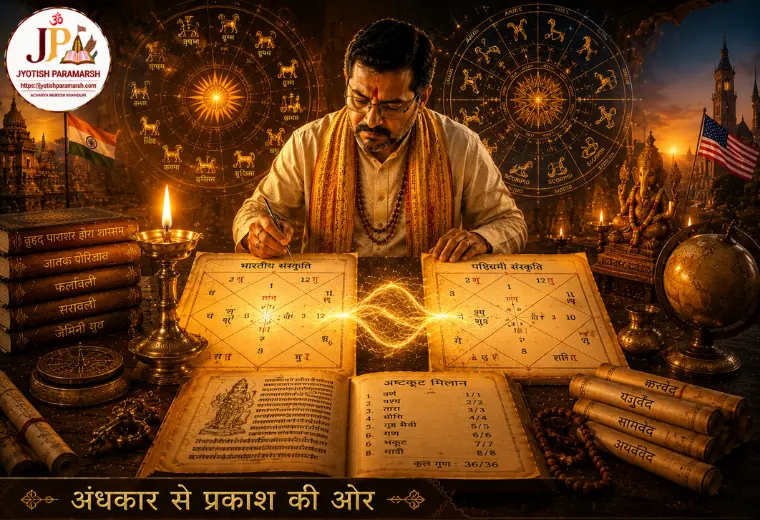
What is Intercaste Marriage in Astrology?
Intercaste Marriage in Astrology refers to the traditional Vedic study of planetary combinations that may indicate the possibility of a person marrying someone from a different caste, community, cultural background, or social group. Such indications are always analysed along with the complete horoscope rather than through a single yoga.
Quick Answer
Intercaste Marriage in Astrology is evaluated by studying the complete birth chart, especially the 5th house, 7th house, Rahu, Venus, Navamsa (D9), planetary periods, and overall marriage yogas. No single planet or combination guarantees an intercaste marriage.
Key Takeaways
- The complete horoscope is more important than one planetary combination.
- Rahu is traditionally associated with unconventional choices.
- The 5th and 7th houses play significant roles in love and marriage.
- Navamsa (D9) should always be examined.
- Planetary periods may activate marriage-related events.
- Personal choice, family values, and circumstances remain equally important.
Table of Contents
- What is Intercaste Marriage in Astrology?
- Why Complete Horoscope Analysis Matters
- Important Houses
- Important Planets
- Common Astrological Combinations
- Myths and Facts
- FAQs
- Conclusion
Why Complete Horoscope Analysis Matters
One of the biggest misconceptions is that a single yoga can confirm an intercaste marriage.
In reality, experienced astrologers examine:
- Birth chart (D1)
- Navamsa (D9)
- Seventh house
- Seventh lord
- Fifth house
- Eleventh house
- Venus
- Jupiter
- Moon
- Rahu and Ketu
- Planetary strengths
- Mahadasha and Antardasha
Only after analysing all these factors together can meaningful guidance be provided.
Intercaste Marriage in Astrology should always be interpreted through a comprehensive study of the birth chart rather than relying on a single planetary combination.
To understand traditional marriage compatibility in detail, read our complete guide on Horoscope Matching.
Important Houses for Intercaste Marriage in Astrology
Several houses are traditionally considered important while studying Intercaste Marriage in Astrology.
1. Fifth House
The fifth house primarily represents:
- Love
- Romance
- Attraction
- Emotional relationships
- Personal choice
A strong relationship between the fifth house and the seventh house is sometimes interpreted as increasing the possibility of a love-based marriage.
In Intercaste Marriage in Astrology, the fifth house is carefully analysed because it reflects personal choice, romance, and emotional attachment.
2. Seventh House
The seventh house is the principal house of marriage.
Astrologers examine:
- Seventh lord
- Occupying planets
- Benefic influences
- Malefic influences
- Planetary aspects
The condition of the seventh house provides valuable information regarding marital life.
The seventh house remains one of the most important foundations of Intercaste Marriage in Astrology because it governs marriage and long-term partnerships.
3. Ninth House
The ninth house represents:
- Family traditions
- Dharma
- Cultural beliefs
- Social values
- Ancestral customs
Some traditional astrologers study the interaction between the ninth house and Rahu while evaluating unconventional marriage patterns.
4. Eleventh House
The eleventh house represents:
- Fulfilment of desires
- Social circles
- Friendships
- Networks
- Long-term aspirations
Its connection with marriage-related houses may contribute to broader relationship possibilities.
You may also find our comprehensive article on Marriage Yog in Kundli helpful for understanding marriage-related planetary combinations.
Important Planets in Intercaste Marriage in Astrology
Planetary analysis forms an essential part of Intercaste Marriage in Astrology.
Rahu
Among all planets, Rahu is most frequently associated with unconventional experiences.
Traditional interpretations associate Rahu with:
- Breaking conventions
- Foreign influences
- Different cultures
- New experiences
- Non-traditional choices
However, Rahu alone does not indicate an intercaste marriage.
Although Rahu is frequently discussed in Intercaste Marriage in Astrology, experienced astrologers always study its placement along with other planetary influences.
Venus
Venus is the natural significator of:
- Love
- Marriage
- Relationships
- Attraction
- Harmony
Its dignity, strength, and association with other planets are carefully analysed.
Moon
The Moon represents:
- Emotions
- Mental compatibility
- Personal preferences
- Emotional security
A strong Moon often supports emotional understanding within relationships.
Saturn
Saturn traditionally represents:
- Social structure
- Discipline
- Responsibility
- Patience
- Long-term commitment
Some astrologers analyse Saturn’s influence while studying marriages that involve social differences.
Mercury
Mercury governs:
- Communication
- Intelligence
- Adaptability
- Flexibility
- Social interaction
Its relationship with Venus and the seventh house may also be considered during horoscope analysis.
Common Astrological Combinations
Some traditional combinations are occasionally discussed while studying Intercaste Marriage in Astrology. These combinations should always be interpreted within the context of the complete birth chart.
Examples include:
- Connection between the fifth and seventh houses.
- Rahu influencing the seventh house or its lord.
- Venus associated with Rahu.
- Strong eleventh house supporting personal desires.
- Navamsa reinforcing marriage-related indications.
- Beneficial planetary periods activating marriage yogas.
None of these combinations independently confirms an intercaste marriage.
Role of Navamsa (D9)
Navamsa is considered one of the most important divisional charts for marriage.
Astrologers use Navamsa to evaluate:
- Marriage stability
- Spouse-related indications
- Planetary strength
- Marriage yogas
- Long-term compatibility
Without analysing Navamsa, horoscope interpretation remains incomplete.
A complete analysis of Intercaste Marriage in Astrology is considered incomplete without evaluating the Navamsa (D9) chart.
Our detailed guide on Ashta Koota Matching explains the traditional 36-point compatibility system used before marriage.
Learn how Guna Milan complements complete horoscope analysis during marriage matching.
Mahadasha and Antardasha
Even when favourable combinations exist, marriage generally takes place only during supportive planetary periods.
Astrologers therefore analyse:
- Mahadasha
- Antardasha
- Transit (Gochar)
- Marriage yogas
The timing of marriage is never determined solely by planetary combinations.
Does Rahu Always Indicate an Intercaste Marriage?
No.
One of the most common misconceptions is that Rahu automatically indicates an intercaste marriage. In traditional Vedic astrology, Rahu is often associated with unconventional paths, foreign influences, and breaking established norms. However, Intercaste Marriage in Astrology is never judged by Rahu alone.
Experienced astrologers also evaluate:
- The condition of the seventh house
- The seventh lord
- The fifth house
- Venus
- Navamsa (D9)
- Planetary aspects
- Marriage yogas
- Running Mahadasha and Antardasha
Only a combined analysis provides meaningful insights.
Can an Arranged Marriage Also Be Intercaste?
Yes.
Many people assume that intercaste marriages always result from love relationships. In reality, an arranged marriage can also be an intercaste marriage if both families agree to the alliance.
From a traditional astrological perspective, the nature of the marriage—love or arranged—and the social background of the couple are analysed separately.
Love Marriage vs Intercaste Marriage
These two concepts are often confused but are not identical.
| Love Marriage | Intercaste Marriage |
|---|---|
| Based on personal choice | Based on partners belonging to different castes or communities |
| May or may not be intercaste | May be arranged or based on love |
| Evaluated through love-related combinations | Evaluated through broader horoscope analysis |
A love marriage may occur within the same caste, while an intercaste marriage may happen through either family arrangements or personal choice.
Common Myths About Intercaste Marriage in Astrology
Myth 1: Rahu Always Causes an Intercaste Marriage
Reality: Rahu is traditionally linked with unconventional tendencies, but no single planet can confirm an intercaste marriage.
Myth 2: One Yoga Is Enough
Reality: Intercaste Marriage in Astrology requires the study of the complete horoscope, not just one planetary combination.
Myth 3: Every Love Marriage Is Intercaste
Reality: Many love marriages take place within the same caste or community.
Myth 4: Astrology Can Guarantee Marriage Outcomes
Reality: Astrology provides traditional guidance based on planetary patterns. It does not guarantee future events.
Myth 5: Online Reports Provide Complete Answers
Reality: Automated reports cannot fully analyse planetary strength, divisional charts, yogas, or individual life circumstances.
You should also explore our articles on Mangal Dosha, Nadi Dosha, and Bhakoot Dosha, which are important topics in traditional marriage astrology.
Online Reports vs Professional Horoscope Analysis
Many websites offer instant compatibility reports and marriage predictions. While these tools may provide basic information, they cannot replace a personalised horoscope study.
| Feature | Online Report | Professional Analysis |
| Basic Horoscope Reading | ✔ | ✔ |
| Marriage Yogas | Limited | ✔ |
| Navamsa (D9) Analysis | Usually Limited | ✔ |
| Planetary Strength | Limited | ✔ |
| Mahadasha Analysis | ✘ | ✔ |
| Personal Consultation | ✘ | ✔ |
| Practical Guidance | ✘ | ✔ |
Spiritual Practices Followed Before Marriage
Many families combine horoscope analysis with traditional spiritual practices.
These may include:
- Worship of Lord Shiva and Goddess Parvati
- Mahamrityunjaya Mantra chanting
- Hanuman Chalisa recitation
- Rudrabhishek
- Charity and selfless service
- Guidance from an experienced Vedic astrologer
These practices are followed with faith and devotion and are not viewed as guarantees of any particular outcome.
Many devotees also perform Rudrabhishek while praying for harmony and stability in married life.
Our detailed guide on the Mahamrityunjaya Mantra explains its traditional spiritual significance.
Many Hindu families also consult a traditional Panchang while selecting auspicious marriage dates and Muhurat according to Vedic customs.
Practical Factors Matter Too
A successful marriage depends on much more than planetary combinations.
Important real-life considerations include:
- Mutual respect
- Honest communication
- Emotional maturity
- Shared values
- Family support
- Financial stability
- Compatibility of life goals
- Commitment and trust
Astrological guidance is most useful when combined with thoughtful personal decisions.
Benefits of Professional Horoscope Analysis
1. Complete Birth Chart Evaluation
An experienced astrologer studies the entire horoscope instead of relying on a single combination.
2. Personalised Guidance
Every horoscope is unique, making individual analysis essential.
3. Better Understanding of Marriage Yogas
Planetary combinations are interpreted within the context of the complete birth chart.
4. Accurate Timing Analysis
Marriage timing is evaluated through Mahadasha, Antardasha, and planetary transits.
5. Traditional Spiritual Guidance
Where appropriate, suitable Vedic practices and spiritual remedies may be suggested based on the individual’s horoscope.
Professional consultation helps individuals understand Intercaste Marriage in Astrology in the context of their unique birth chart and life circumstances.
FREE Garhwali Bride & Groom Registration
Looking for a suitable Garhwali bride or groom?
Jyotish Paramarsh offers dedicated matchmaking support for Garhwali families.
Limited-Time Offer
✅ FREE Registration
Services include:
- Personalised Matchmaking
- Horoscope Matching
- Kundli Matching
- Marriage Compatibility Analysis
- Marriage Yog Consultation
- Vedic Astrology Guidance
📞 Call / WhatsApp: +91 95576 09725
🌐 Website: https://jyotishparamarsh.com/matrimony-and-marriage-registration/
Every case of Intercaste Marriage in Astrology should be assessed individually because no two horoscopes are exactly alike.
If you are comparing different marriage paths, read our detailed article on Love Marriage vs Arranged Marriage in Astrology.
Several concepts discussed in Vedic marriage astrology are preserved in classical Sanskrit literature, which continues to be studied by scholars and students of Jyotish.
Conclusion
Intercaste Marriage in Astrology is a detailed area of Vedic astrology that requires careful interpretation of the complete birth chart. Rather than relying on a single planet, yoga, or online compatibility report, experienced astrologers analyse the seventh house, fifth house, Navamsa (D9), planetary strengths, marriage yogas, and planetary periods before offering guidance.
At the same time, successful marriages are built on understanding, respect, trust, communication, and shared life goals. Astrology can serve as a traditional guide, but personal choices and mutual commitment remain equally important.
Frequently Asked Questions (FAQ)
What is Intercaste Marriage in Astrology?
Intercaste Marriage in Astrology is the traditional Vedic study of planetary combinations that may indicate the possibility of marriage with someone from a different caste, community, or social background.
Which planet is associated with intercaste marriage?
Some traditional interpretations associate Rahu with unconventional choices. However, no planet alone confirms an intercaste marriage.
Does Rahu always indicate an intercaste marriage?
No. Rahu is only one factor among many considered during horoscope analysis.
Which houses are important?
The 5th, 7th, 9th, and 11th houses are commonly studied along with Navamsa (D9) and the complete horoscope.
Can arranged marriages also be intercaste?
Yes. An arranged marriage may also involve partners from different castes or communities.
Can astrology guarantee an intercaste marriage?
No. Astrology provides traditional guidance based on planetary patterns and should not be viewed as guaranteeing future events.
Is Navamsa important?
Yes. Navamsa (D9) is considered essential for analysing marriage-related matters in Vedic astrology.
Are online reports sufficient?
No. Personalised consultation provides a far more comprehensive analysis than automated reports.
Should love marriage couples also consult an astrologer?
Many couples choose to seek traditional astrological guidance regardless of whether the marriage is based on love or family arrangements.
What is more important than planetary combinations?
Mutual respect, communication, emotional maturity, shared values, trust, and thoughtful decision-making remain the foundation of a successful marriage.